
6 Medical Device Applications for Heat Shrink Tubing
Heat shrink tubing for medical devices is used in applications such as jacketing, insulation, strain relief, encapsulation, bonding, and marking. This article focuses specifically on Pebax® and Polyolefin Heat Shrink Tubing.
Unlike heat shrink used only as a processing aid, Pebax and Polyolefin Heat Shrink Tubing can become part of the final device construction. When selected and applied correctly, they can help simplify construction, reduce material layers, or solve performance challenges.
Understanding how these materials behave during recovery is key to selecting the right material, shrink ratio, and wall thickness for your application.
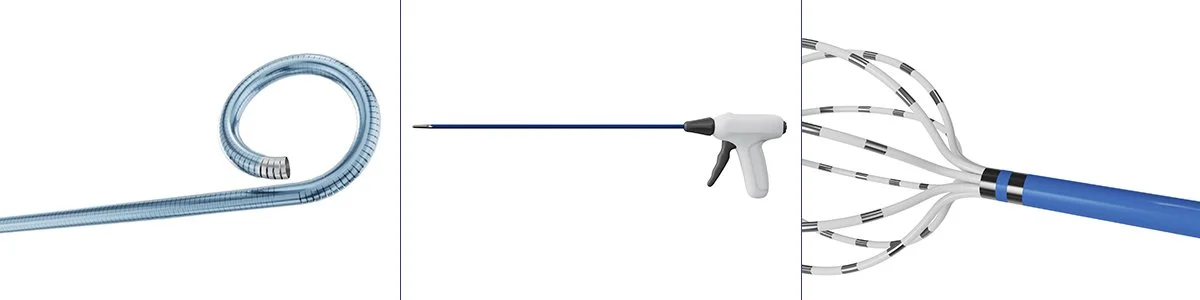
The full paper explains six medical device applications for Pebax and Polyolefin Heat Shrink Tubing, including:
Jacketing of Laser-Cut Hypotubes: As catheter construction continues shifting toward laser-cut hypotubes, engineers are looking for ways to maintain flexibility while simplifying shaft construction. In many designs, Pebax Heat Shrink Tubing can function as the outer layer while eliminating cumbersome reflow steps.
Electrical Insulation: For electrosurgical instruments and powered devices, insulation needs to be thin, durable, and consistent. Polyolefin Heat Shrink Tubing provides electrical insulation without significantly increasing the profile of the device.
Strain Relief: Areas of a device that experience repeated bending or mechanical stress, such as shaft transitions and component interfaces, are prone to fatigue, kinking, or material separation if not properly supported. Heat shrink tubing can provide a localized reinforcement layer that helps distribute stress while maintaining flexibility.
Encapsulation: Encapsulation covers discrete components or localized regions of a device, such as marker bands, coils, or sensors. Pebax and Polyolefin Heat Shrink Tubing recover uniformly over these features, helping maintain coverage and dimensional control with less wall thickness variability than processes such as dip coating or reflow.
Bonding, Termination and Finishing: Bonding, termination, and finishing often happen at transitions between materials, cut edges, and joined components. Pebax Heat Shrink Tubing can bond materials and create a smooth, finished surface in a single step, reducing the need for adhesives or tie layers while keeping transitions thin and consistent.
Marking and Identification: Pebax and Polyolefin Heat Shrink Tubing can support device marking and identification in two ways: the tubing itself can serve as the marker through color differentiation, or it can be pad printed, silk screen printed, and laser printed with depth indicators, branding, or part identification.
If you’re evaluating heat shrink tubing for a new device or trying to solve a specific manufacturing challenge, understanding how these materials behave is critical.
Complete this form to download “6 Key Applications for Pebax® and Polyolefin Heat Shrink Tubing in Medical Devices” to take a deeper look at these applications.